How Associations Can Adapt as Search Shifts From Clicks to Answers
For years, associations have relied on a familiar digital funnel: drive awareness through search, bring users to the website, nurture interest, and convert them into members, advocates, donors, or engaged participants.
But that funnel is changing.
As AI-powered search tools, answer engines, and large language models become more central to how people discover information, users are increasingly getting what they need without ever clicking through to a website. The “front door” to the internet is moving — and associations need to understand what that means for visibility, authority, and member acquisition.
In this webinar, Accella’s Alyssa Hulka, Chief Experience Officer, and Merrik Kressley, Senior Digital Strategist, joined Michael Deckman of Federal Hearings and Appeals Services (FHAS) to discuss how Answer Engine Optimization, or AEO, is reshaping the member acquisition funnel and what associations can do now to stay discoverable, credible, and competitive.
If your association depends on organic search, thought leadership, public education, advocacy, or industry authority to attract and engage audiences, this conversation is a timely reminder: being found is no longer just about ranking. It’s about being included in the answer.
As Alyssa Hulka explained at the top of the webinar, “Awareness, interest, desire, all these things have collapsed at the top of the funnel, and that is because of the change in search behaviors.”
The Funnel Has Changed
Traditional SEO has long focused on getting users to click.
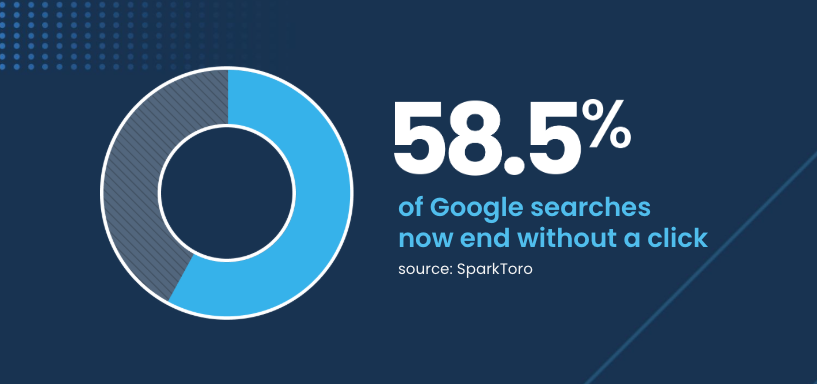
But today, many searches end before a user ever reaches a website. According to Sparktoro, 58.5% of Google searches now end without a click, shifting the value of search from traffic alone to visibility, authority, and inclusion in AI-generated answers.
That change has real implications for associations.
Historically, the digital acquisition funnel moved users from awareness to interest, then desire, then action. But AI-powered search is compressing the top and middle of that funnel. A prospective member, partner, policymaker, or funder may ask a question, receive a synthesized answer, and make a decision about who is credible before ever visiting your website.
Michael made a really good point saying: “They’re researching you, they’re researching competitors, but they’re doing it without ever coming to the website. They’re figuring out who they want to work with before they ever interact with the brand directly.”
In this new environment, your association’s content still matters, but it needs to be structured, accessible, and authoritative enough for AI systems to recognize and reuse.
The goal is no longer just to win the click. The goal is to become a trusted source.
From Keywords to Intent
SEO is not going away. Technical SEO, content structure, backlinks, and website performance still matter. But AEO builds on that foundation by asking a broader question: When someone asks an AI tool about your industry, issue area, service, or community, will your organization show up in the answer?
That requires a shift from keyword optimization to intent optimization.
Merrick suggested “Instead of optimizing for the key phrase and the blue link, you’re optimizing for the mention, the citation.“
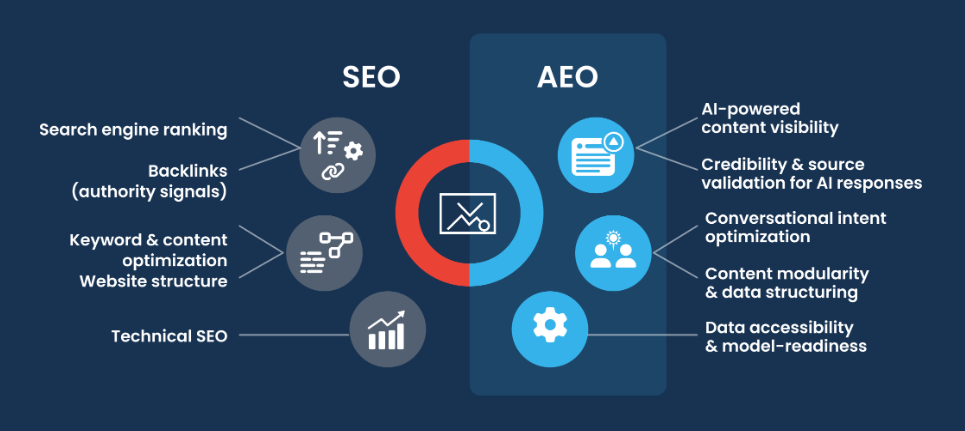
Traditional SEO focuses heavily on search engine rankings, backlinks, keyword targeting, website structure, and technical performance. AEO expands that work to include AI-powered content visibility, credibility and source validation, conversational intent optimization, content modularity, data structuring, and model-readiness.
For associations, this means your content needs to reflect the language real users use when they ask questions, not just the terminology your organization uses internally.
It also means your most valuable public-facing knowledge needs to be easy for both humans and machines to understand.
What Associations Can Do Now
The good news: associations do not need to overhaul everything overnight. But they do need to start. Here are a few practical places to begin:
1. Create Content in End-User Language
Associations often publish content from an internal or expert point of view. That can be valuable, but it may not match how a prospective member, stakeholder, or industry newcomer asks a question.
AEO requires associations to think more intentionally about user language.
What would someone ask if they were new to your field? What do they need explained in plain terms? What challenges are they trying to solve? What trends are they trying to understand?
Explainer content, glossary-style resources, FAQs, and practical guides can help bridge the gap between expert knowledge and real-world search behavior.
– Michael “If we don’t really understand or have a pulse on our target audience and what terminology and language they’re using to describe the topics that we’re relevant for, then we’re really disadvantaged.” Michael dug even further saying – “Pay attention not only to what the topic is, but the words they’re using.”
2. Publish Timely, Topically Relevant Content
AI-powered search systems look for signals of relevance, authority, and freshness.
Associations are often sitting on timely expertise, policy updates, research, standards, member insights, industry trends, conference takeaways, and educational resources. But if that content is buried, outdated, gated, or locked in PDFs, it may not contribute to your visibility.
A strong AEO strategy includes a plan for publishing timely content in formats that are easy to discover, crawl, and cite.
– Michael shared an example where AI tools cited FHAS content repeatedly while he was researching a complex healthcare policy document:
“There were 10 citations in the document. Five of them were from FHAS, my own company. All five citations were blog articles.”
3. Revisit Public vs. Members-Only Content
Member value is important. But associations should take a closer look at what belongs behind a login and what should remain public to build authority.
If your most credible, useful, or explanatory content is entirely gated, AI tools may not be able to access it. That can limit your organization’s ability to show up in answers, even when you are the most qualified source.
This does not mean giving everything away. It means being strategic.
Merrick shared “A lot of that core goldmine type content that would do really well to help feed and boost authority with LLMs is actually behind the gate and members only. We have to find a middle ground.”
Some content should drive public authority and visibility. Other content can remain exclusive to members. The key is understanding which assets support acquisition and which assets support retention.
4. Create Content for Navigation and for AI
Your website still needs to serve users who arrive directly. Clear navigation, landing pages, and conversion paths remain essential.
But your content also needs to work for AI systems that may extract, summarize, or cite individual pieces of information.
That means content should be modular, structured, and easy to interpret. Strong headings, concise answers, schema, metadata, and clean page architecture all help make your content more useful beyond the website itself.
How to Understand Real User Intent
One of the most practical exercises from the webinar is also one of the easiest to start: use AI tools the way your audience would.
Start by evaluating your topics across multiple models.
The point is not to treat AI answers as perfect. The point is to understand what these tools know, what they misunderstand, what sources they appear to trust, and where your organization may be missing from the conversation.
Repeat the queries across models like ChatGPT, Claude, Gemini, and Perplexity to identify patterns.
AEO Is a Communications Channel, Not a Campaign
One of the most important mindset shifts for associations is to stop thinking of AEO as a one-time optimization project. AEO is a long-term communications strategy.
When LinkedIn, Facebook, and other platforms became important channels, organizations eventually developed organic and paid strategies for each one. AI-powered answer engines now deserve the same level of strategic attention.
Your association is investing in two things:
- A visibility and authority strategy.
- A long-term communications strategy, not a campaign.
That distinction matters. AEO is not something you “finish.” It is something you build into your content, website, communications, and technical roadmap over time.
Technical Remediation Still Matters
Content strategy is only part of the equation.
If AI systems cannot crawl, access, or understand your website, even strong content may underperform.
That is why technical remediation should be part of any AEO roadmap. Associations should evaluate whether their websites are supporting or limiting discoverability through factors such as crawlability, page structure, schema, site speed, mobile performance, accessibility, and content formatting.
You can start with two simple steps: use AI tools the same way your audience would, then begin the technical remediation needed to make your content more accessible and model-ready.
For organizations that are not sure where to begin, Accella also offers a free AEO Technical Assessment Report to help identify opportunities for improvement.
Final Thought
The member acquisition funnel is not disappearing. But it is changing.
As AI tools become a more common starting point for discovery, associations need to rethink how they build awareness, establish authority, and move audiences toward action.
AEO is not just a marketing trend. It is a shift in how people find and evaluate information. Associations that act now will be better positioned to shape the answers being delivered about their industries, their issues, and their communities.
Michael noted that “Everybody is starting from the starting line right now.”
The question is no longer only, “Can people find your website?”
The question is, “When people ask about your space, are you part of the answer?”
Michaels final piece of advice is “Write often. Write relevant. Be authentic.”
Want to Learn More?
If you have questions about AEO or want to understand how visible your association is in AI-powered search, Accella can help.
Get started with a free AEO Technical Assessment Report or reach out to the Accella team to learn more.
Attending ASAE MMC+ Tech Conference 2026? Join one of our two sessions:
- Escape AI Paralysis: Map the Journey, Then Add AI
- Presented by Jason King, President, Accella
- Thursday, May 28, 9:00-10:00AM ET
- Stop Hiding The Good Stuff: How AI Rewards High-Volume Insight
- Presented by Kelsey Mills, Senior Digital Strategist, Accella
- Thursday, May 28, 3:30-5:00PM ET
FAQs: Key Takeaways from the Webinar
What is AEO?
AEO stands for Answer Engine Optimization. It is the practice of improving your organization’s visibility in AI-generated answers, search summaries, and conversational search tools.
Where SEO focuses on ranking in traditional search results, AEO focuses on whether your organization’s content is trusted, understood, and surfaced by AI-powered systems.
How does AEO affect the member acquisition funnel?
AEO changes how people move from awareness to action.
Prospective members or stakeholders may now encounter your association through an AI-generated answer rather than a website visit. That means your credibility may be established, or lost, before someone ever clicks.
Associations need to ensure their expertise is visible in the places where people are asking questions.
Does AEO replace SEO?
No. AEO builds on SEO.
Technical SEO, strong content, site structure, and authority signals are still foundational. But AEO expands the strategy to include conversational intent, AI visibility, structured data, source validation, and content accessibility.
Why should associations care about zero-click searches?
When users get answers directly in search results or AI tools, website traffic may decline even if your audience is still searching for your topics.
That does not mean search is less important. It means the measure of success is changing.
Associations need to think beyond clicks and consider visibility, authority, citations, mentions, and influence within AI-generated answers.
What types of content help with AEO?
Useful AEO-friendly content often includes:
- Clear explainer pages
- FAQ-style content
- Timely industry updates
- Definitions and glossaries
- Research summaries
- Public-facing educational resources
- Structured HTML content
- Content written in user-centered language
The most effective content answers real questions clearly and directly.
Should associations ungate all of their content?
No. But they should revisit their public vs. members-only strategy.
Some content should remain exclusive. But content that establishes authority, answers common questions, supports public education, or helps prospective members understand your value may need to be publicly accessible to support AEO.
How can associations get started without overthinking it?
Start by using AI tools the way your audience would. Search for your topics, your services, your competitors, and your organization. Look for where you appear, where you do not, and how accurately your space is represented.
Then, evaluate your technical foundation and begin addressing the barriers that may prevent AI tools from accessing or understanding your content.